
Reviewer Role
-
Contribution to Editorial Decisions: Peer review assists the editor in making editorial decisions and through the editorial communications with the author may also assist the author in improving the paper.
-
Standards of Objectivity: Reviews should be conducted objectively. Personal criticism of the author is inappropriate. Reviewers should express their views clearly with supporting arguments.
-
Disclosure and Conflict of Interest: Privileged information or ideas obtained through peer review must be kept confidential and not used for personal advantage. Reviewers should not consider manuscripts in which they have conflicts of interest resulting from competitive, collaborative, or other relationships or connections with any of the authors, companies, or institutions connected to the papers under consideration.
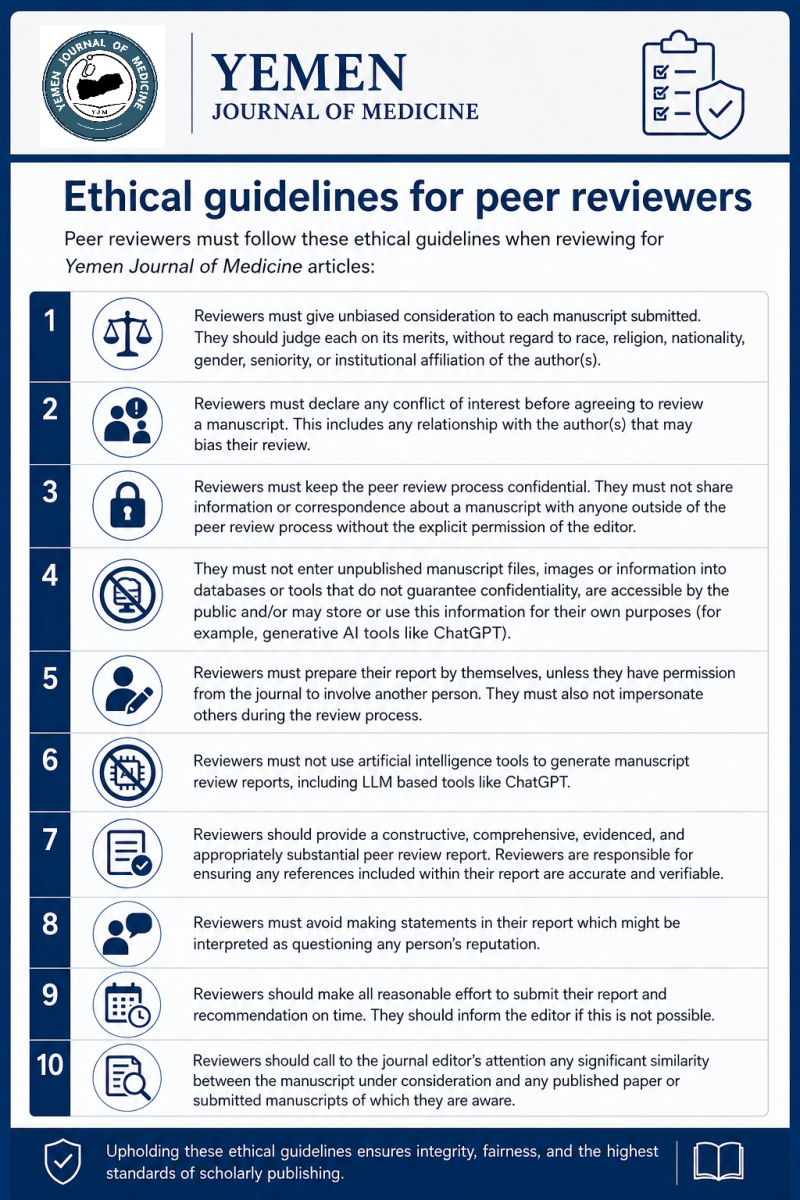
When invited to peer review, you'll receive the manuscript's abstract to help you decide whether to accept the invitation and conduct the review. Respond promptly to avoid delays and declare any potential conflicts of interest early. Editors rely on timely, constructive feedback for decision-making. Provide clear, helpful comments—vague or unhelpful ones offer little value. Your review should include comments to the authors and possibly confidential ones to the editors. Remember, while peer review is often anonymous, never include anything in your report that you wouldn't discuss with the author in person. Click here to download the reviewers Manual
|
Stage |
Step |
Reviewer Actions |
Key Questions / Considerations |
|
1. Invitation to Review |
Assess suitability |
Read the abstract, evaluate expertise, availability, and possible conflicts of interest. Respond promptly to the invitation. |
Am I qualified to review this manuscript? Do I have any conflicts of interest? Can I complete the review on time? |
|
2. Preparation |
Understand the study |
Review the abstract carefully to identify the research question, methods, major findings, and conclusions. |
Are the aims, methods, and conclusions clearly presented? |
|
3. First Read-Through |
Initial assessment |
Perform a rapid read of the entire manuscript to gain an overall impression. Take notes and record relevant page or line numbers. |
Is the manuscript potentially acceptable, revisable, or unsuitable for publication? |
|
4. Evaluate Relevance and Originality |
Assess scientific contribution |
Determine whether the research question is important, novel, and relevant to the field. |
Does the study add meaningful knowledge beyond existing literature? |
|
5. Assess Clarity and Logic |
Review presentation |
Examine the organization, writing quality, and logical flow of arguments. |
Are the conclusions supported by the evidence presented? |
|
6. Review Data Presentation |
Examine tables and figures |
Assess whether tables, figures, and images are necessary, clear, and supportive of the findings. |
Do visual elements effectively communicate the results? |
|
7. Identify Major Flaws |
Detect critical issues |
Look for methodological weaknesses, unsupported conclusions, missing key variables, or flawed analyses. |
Are there serious concerns affecting the validity of the findings? |
|
8. Assess Methodology |
Evaluate study design |
Review sampling, controls, data collection, analytical methods, and reproducibility. |
Are the methods appropriate, rigorous, and adequately described? |
|
9. Assess Data Quality |
Verify evidence |
Examine data consistency, completeness, and alignment with conclusions. |
Are the data sufficient, reliable, and internally consistent? |
|
10. Draft Initial Review Summary |
Prepare overview |
Write a concise summary of the study’s objectives, methods, findings, and significance. |
What are the strengths and overall contribution of the manuscript? |
|
11. Provide Conceptual Assessment |
Evaluate impact |
Discuss novelty, scientific value, methodological soundness, and reliability of results. |
Does the manuscript make a meaningful contribution to the field? |
|
12. Read Entire Manuscript |
Confirm impressions |
Conduct a complete review, including strengths and weaknesses, before making recommendations. |
Are initial concerns supported after a full reading? |
|
13. Second Read-Through |
Detailed evaluation |
Carefully review all sections for accuracy, completeness, and areas requiring revision. |
Does the manuscript meet publication standards after detailed scrutiny? |
|
14. Assess Argument Construction |
Review reasoning |
Identify unclear statements, unsupported claims, factual errors, and logical inconsistencies. |
Is the scientific argument coherent and evidence-based? |
|
15. Evaluate Title, Abstract, and Keywords |
Check consistency |
Ensure that title, abstract, and keywords accurately reflect the manuscript content. |
Are the key messages concise, accurate, and accessible? |
|
16. Assess Language and Readability |
Evaluate clarity |
Focus on whether the manuscript's meaning is understandable rather than correcting grammar. |
Does language hinder scientific interpretation? |
|
17. Organize Comments |
Structure feedback |
Group major concerns, minor concerns, and positive comments separately. |
Are recommendations clear, constructive, and actionable? |
|
18. Prepare Comments to Authors |
Constructive feedback |
Provide specific, evidence-based suggestions for improvement while maintaining a respectful tone. |
Will the comments help authors strengthen the manuscript? |
|
19. Prepare Confidential Comments to Editors |
Editorial guidance |
Share concerns that may not be appropriate for authors, including ethical issues or publication recommendations. |
Are there concerns requiring editorial attention? |
|
20. Final Recommendation |
Submit review |
Recommend one of the following: Accept, Minor Revision, Major Revision, or Reject. Submit the review on time. |
Does the manuscript meet the journal's standards for publication? |
|
Section |
Content |
|
Summary of the Manuscript |
Brief overview of objectives, methods, results, and conclusions |
|
Major Comments |
Significant scientific, methodological, or interpretative concerns |
|
Minor Comments |
Editorial, presentation, or clarification issues |
|
Strengths of the Study |
Novelty, methodological rigor, clinical relevance, or contribution to knowledge |
|
Recommendation |
Accept, Minor Revision, Major Revision, or Reject |
|
Confidential Comments to Editor |
Optional comments regarding publication suitability or ethical concerns |